

|

![[Image]](mofepmed.gif)
250 million years B.C. - 1988
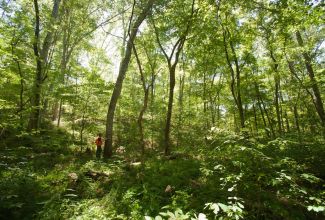
Since dinosaurs ruled the earth, southern Missouri
has been covered in rich lush forest. Its wide variety of trees and
wildlife was what drew early settlers to the state. Ironically, by 1930,
the very thing on which early settlers depended for their livelihood had
nearly disappeared.
![[Image]](mofep1sl.gif)
Thanks to better education and conservation practices, forests that had
once nearly vanished because of overuse now cover more than 14 million
acres in Missouri, and they
continue to grow every year. The land cleared at the turn of the century
has regenerated into the healthy forests we have today. But our
conservation education doesn't stop there.
We have a great responsibility as caretakers of this land. While the
demand for wood products continues to rise, increasingly better knowledge
and understanding of the environment is changing the way landowners manage
their forests. Our actions today create thousands of reactions tomorrow we
may not be able to see, but may be vitally important to the earth's
ecological balance.
![[Image]](mofep2sl.gif)
As caretakers, we need to know about these reactions in order to
conserve healthy forest ecosystems. Until this century, settlers thought
forest resources would last forever. But the trees nearly vanished, taking
with them everything from birds, flowers, mice and lizards to insects, soil
and nutrients, all of which comprise a forest ecosystem. All are equally
important.
To determine the ongoing and future needs of Missouri's
forests, the Missouri Department of Conservation has undertaken a massive
project that will offer valuable data in a long-term, top-to-bottom study
of the Ozark forest resource. The Missouri Ozark Forest Ecosystem Project
(MOFEP) will provide the foundation to decide the best ways to satisfy demands
for wood products while ensuring the survival of healthy forest ecosystems.
![[Image]](mofep3sl.gif)
The Seed Is Planted: 1988
MOFEP's inception was the result of a conversation
between a Missouri Department of Conservation research biologist and a University
of Missouri professor who
wanted to know what effect Missouri
forest management was having on songbird populations locally and
internationally. They talked with another Department research biologist,
presenting their idea, and the seed for the project was planted.
The three scientists decided they needed assistance to further develop
the project, and presented it to research biologists in the Department of
Conservation's Wildlife Division. In turn, Wildlife Division scientists
asked for assistance from Forestry Division's newly formed research
section. The Wildlife and Forestry divisions agreed to work together on the
project with the help of the University
of Missouri, and the Missouri
Ozark Forest Ecosystem Project was born.
![[Image]](mofep4sl.gif)
The Seed Sprouts: 1990
MOFEP scientists' first challenge was to find enough land to accommodate
the project. The tracts had to be spacious, and had to be made up entirely
of areas that hadn't been logged in at least 20 years. The answer came from
the heavily forested Ozarks. As a results, 9,200
acres of state forest land are now divided into nine areas called
compartments - ranging from 650 to 1,300 acres in size. Each compartment
will receive one of three kinds of forest management: evenaged
management, unevenaged management and a
"control" group. The management treatments were randomly assigned
to avoid any bias in the study.
![[Image]](mofep18sl.gif) ![[Image]](flowerssl.gif)
Three of the compartments will receive a series of regeneration cuts,
which are part of the evenaged management system.
This management method results in groups, or stands, of trees of roughly
the same size and age growing together, Missouri
regeneration cuts produce stands about two to 25 acres in size.
Cuts are made on rotation schedule in which roughly 10 percent of each
compartment will be cut every ten years or so, and will not be cut, again
during the study. Another 10 percent of these compartments will be set
aside as old growth, which means these areas will never be cut.
![[Image]](mofep16sl.gif)
An unevenaged
management system will be used for three other compartments. This is a
selective harvest that cuts only certain trees, resulting in a forest with
different ages and sizes of trees. Again, selective cuts will be conducted
about every ten years. As with evenaged
management this system will designate about 10 percent of the compartment
as "old growth." Except for the old growth area, all compartment
forests will have regenerated by the end of the project.
The three remaining compartments will act as control groups. These compartments
will be left alone to mature as they naturally would without cutting or
harvesting. As with any forest, these control areas will change too.
However, the changes will not be influenced by cutting as with the other
treatments.
The Seedling Grows: 1990-1995
Prior to cutting, MOFEP scientists are gathering pre-treatment
information on the land. This information comes from research into forest
vegetation, songbirds, small mammals, reptiles and amphibians, and the
insects and invertebrates that make up this ecosystem.
In all, scientists are currently conducting 12 far-reaching studies on
MOFEP sites, and new studies will be added throughout the life of the
project. The entire project is now on a 100-year schedule. This does not
mean, however, that researchers will wait a full century to report
important information. Data that has already been collected on MOFEP is
being analyzed. This long-term project provides a unique opportunity to
view the responses of complex forest ecosystems to current forest
management practices.
MOFEP is a tremendous undertaking by the Missouri Department of
Conservation, and a large number of studies on various elements of forest
ecosystems are part of the overall project, including:
The Tree's Future: 2095 and Beyond
![[Image]](mofep14sl.gif)
What began as a single idea has grown into the largest and potentially
the longest project of its kind in North America.
Researchers participating in the study include scientists from the Missouri
Department of Conservation, The University of Missouri-Columbia, The
University of Missouri-St. Louis, Southeast
Missouri State
University and the U. S. Forest
Service.
The scientists who created MOFEP probably won't live long enough to see
the project's completion. Nevertheless, They know their idea is breaking
new ground by providing information on the interaction of different
components of forest ecosystems. This could prove to be invaluable in the
future for issues such as gypsy moth infestation, global warming and
biodiversity.
Even in its first stages, information gathered from the project already
has proven valuable to programs worldwide. MOFEP scientists must continue
to be flexible enough to address the problems of today, while predicting
how results will impact future generations tomorrow.
Published by the
Missouri Department of Conservation
Robert L. Ziehmer, Director
Mike Kruse, Resource Science Division Administrator
The Missouri Department of Conservation uses Federal financial
assistance in Sport Fish and/or Wildlife Restoration. Because the state
utilizes these federal funds, it must comply with federal
anti-discrimination law. Under Title VI of the 1964 Civil Rights Act and
section 504 of the Rehabilitation Act of 1973, the federal government
prohibits discrimination on the basis of race, color, national origin,
disability, age or sex. If you believe that you have been discriminated
against in any program, activity of facility as described above, or if you
desire further information please write to:
The Office for Human Resources
U.S. Fish and
Wildlife Service
Department of the Interior
Washington, D.C. 20240
and
Missouri Department of Conservation - Research
Center
1110 S. College Ave.
Columbia, MO 65201
- Written by: Leslie
McClain
- Photography by: Jim Rathert, Paul Childress, Mark Sullivan, and Tom Troughton
Copyright © 1994 by the
Conservation Commission of the State of Missouri
 
Last Updated: September 15, 2011
Please explore the links to the left to learn more about the
Missouri Ozark Forest Ecosystem Project.
|